


Build custom, structured Excel reports from monday.com board data and send them automatically to the right people on schedule.


How to share your monday.com boards with external users and guests
Sharing monday.com boards with external users and guests is easy. In this post, we’ll cover the built-in options, their pros and cons, and why a monday.com client portal is often the best solution.

Table of contents
Use the navigation below to quickly jump to your desired section and learn more about each topic.
Sharing monday.com boards with clients, contractors, freelancers, and other external users can be simple. The challenge is choosing a sharing method that gives people the information they need without exposing internal work or creating unnecessary administration for your team. monday.com provides native options for inviting guests and publishing board views. These options work well in many situations, but they can become limiting when you manage several clients, need more control over visibility, or want to provide a branded client experience.
In this guide, we explain how to share a monday.com board with external users, how guest access works, and when a dedicated monday client portal may be the better solution.
TL;DR
What is the best way to share a monday.com board with external users?
The best method depends on what the external user needs to see and do.
- Use a Shareable Board with guest access when the external user needs to collaborate with your team right inside your monday.com workspace.
- Use a dedicated client portal such as Client Portal Builder for monday.com when each client should see a secure, branded and personalized view of their own projects in a structured way.
- Use a public shared view when the external user only needs to view non confidential information and does not need to edit items or comment.
1. Invite guests to a board
How to invite a guest to a monday.com board
A guest is an external user who has been invited to a Shareable Board. Guests work inside monday.com, but they only have access to the Shareable Boards they have been invited to. They cannot automatically see your other boards or the rest of your account. Learn more about the pros and cons of inviting guests to a board.
Follow these steps to invite a guest
- Open the monday.com board you want to share with a guest
- Click the board name and change its board type to
Shareable - Review board permissions by clicking
···next to the invite button - Invite your external guest user by clicking the
Invitebutton - Enter the email address of your guest below Board guests
- Once the invitation is completed by your guest they gain access

When monday.com guest access works well
Guest access is useful when an external user needs to work closely with your team. It is often a good fit for freelancers, contractors, vendors, consultants, and clients who regularly update tasks or participate directly in a project.
A guest can work with relevant tasks, updates, comments, and files according to the permissions you configure. This makes guest access suitable when the external user needs more than a simple project overview.
Your team can continue using its existing workflow
Your internal team can continue working in monday.com without introducing a separate project management system. The external user joins the relevant Shareable Board and works alongside your team.
Access is limited to invited boards
A guest only sees the Shareable Boards they have been specifically invited to. Main Boards, Private Boards, and unrelated Shareable Boards remain unavailable.
It works well for active project participation
Guest access is useful when the external user needs to update tasks, answer questions, provide information, or work directly with your internal team.
The limitations of monday.com guest access
Guest access works well for direct collaboration, but it is not always the best way to communicate with clients. Specifically when your clients are not familiar with the monday.com workspace user interface.
The client needs to enter monday.com
The client receives an invitation and needs to create a guest profile for your monday.com account. This may be acceptable for regular collaborators, but it can create friction for clients who only want to check progress, review a document, or approve a deliverable.
The client sees the monday.com interface
A Shareable Board still looks and behaves like monday.com. You cannot fully replace the interface with your own client navigation, portal pages, branding, content, and domain.
The guest accesses the actual board
Board permissions control what the guest can change, but the guest still accesses the Shareable Board itself. When your internal board contains information that clients should not see, you may need to restructure the board, create a separate board, hide information, or build additional automations.
Separate boards can become difficult to manage
Creating one Shareable Board for a single client may be straightforward. Creating and maintaining separate boards for dozens of clients can result in duplicated structures, additional automations, and more work for your team.
Guest access has email domain restrictions
A guest generally needs to use an email domain that is different from the domain associated with your organization. Someone using the same company email domain may need to be added as a member instead.
2. Share boards in a client portal
How to share monday.com boards through a client portal
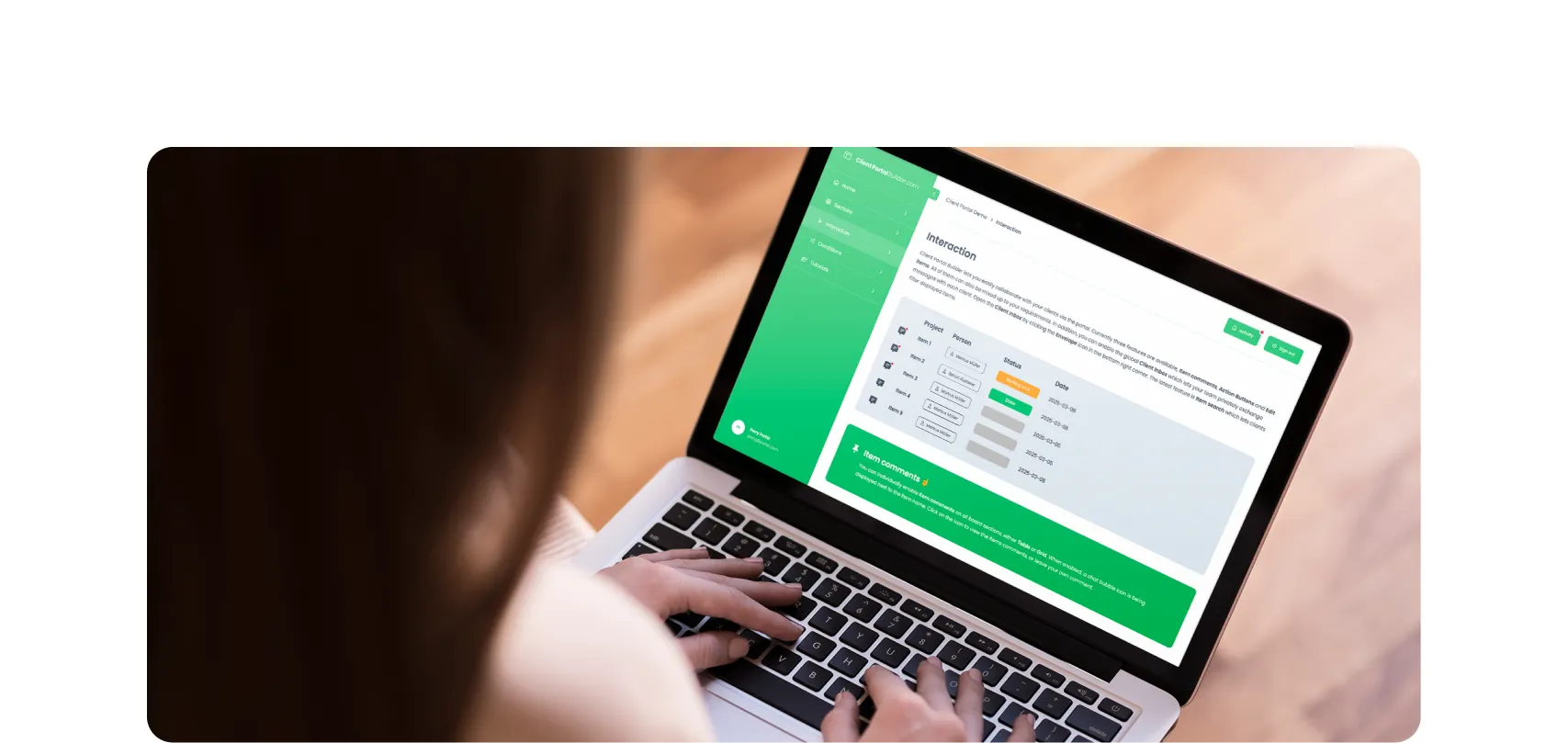
A client portal becomes useful when sharing boards is no longer enough. You may want clients to see project progress without seeing the complete board. You may also want to combine information from several boards, provide your own navigation, or allow clients to communicate with your team without entering your workspace.
How this looks in practice can vary by industry. Explore client portal solutions for different industries, including agencies, consultants, accountants, architects, real estate teams, and other service businesses. If you are still deciding how the portal itself should be built, compare six ways to build a client portal with monday.com, from native and purpose built portals to external and custom applications.
Follow these steps to share boards in a portal
The exact setup depends on your workflow, but the basic process is the following:
- Install the Client Portal Builder for monday.com from the marketplace
- Create or select your Clients Board to manage all your clients
- Add the Client Portal Builder view next to its Main table
- Add a board section and connect the board
- Filter the items and select which columns to show
- Create a login method, publish and share the portal
If you want to learn more about how to get started with monday.com client portals read the in-depth user guide.
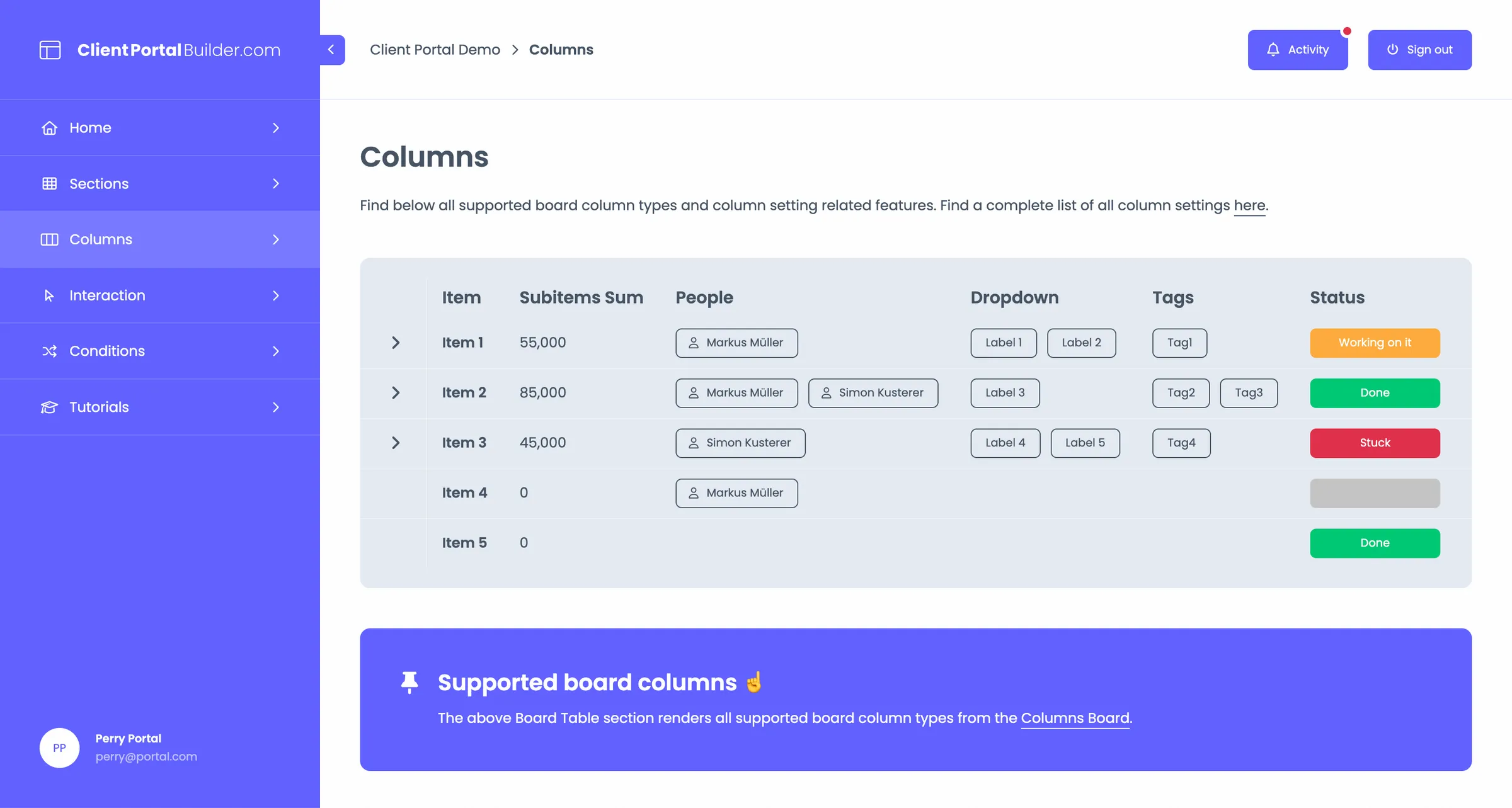
How the client portal workflow works
A typical workflow with Client Portal Builder for monday.com looks like this:
Your team manages its work in monday.com
Your team continues managing projects, requests, documents, and services using its normal monday.com workflow. This can also include client onboarding workflows, where clients provide information, upload files and review onboarding documents through their portal.
Client Portal Builder connects to the relevant boards
You select the boards containing the information that should appear in the client portal. If those client workflows live across several boards, see how to organize monday.com boards into client portal pages and sections.
You choose what clients can see
You select the items, columns, files, pages, and other information that should be visible. Learn how to create personalized client views from your monday.com data so each client sees the items and content relevant to them.
Each client sees their own information
Clients sign in to the portal and see the projects or items associated with them.
Clients interact with the portal
Depending on your configuration, clients can view progress, access files, add comments, or edit selected information.
Changes remain connected to monday.com
Your team continues working in monday.com without needing to update a separate system manually.
What can clients do inside the portal?
The portal can be configured around the way your team already works and remains connected to the monday.com boards your team uses internally.
View client specific projects and items
Clients can see items assigned or connected to them instead of seeing the entire internal board. This allows your team to manage several clients from shared monday.com boards while giving each client a separate view.
Follow project progress
Clients can view selected statuses, deadlines, deliverables, files and follow project updates, support requests, or other relevant board data. The portal remains connected to monday.com, so clients can see current information without your team creating manual reports for every update.
Add comments and share files
Clients can comment on individual items and attach files. Your team can respond through the connected monday.com item, keeping the conversation linked to the relevant task or project. Learn how to organize client communication around monday.com items and general portal messages.
Edit selected information
You can allow clients to update selected items and columns directly from the portal. For example, a client could update a status, enter text, select a date, or upload a file without receiving access to the complete board.
Use a branded experience
You can add your logo, adjust the portal theme, and connect a custom domain. This gives clients an experience that feels connected to your own service rather than to your internal project management system.
Navigate through dedicated portal pages
Portal pages create a clear navigation structure for clients. You could create separate pages for projects, requests, documents, invoices, support, onboarding, or other areas of your client workflow.
See the client experience before installing
Explore the Client Portal Builder for monday.com live demo from a client's perspective. You can adapt all the displayed features in the demo portal to your own use case and workflow.
3. Share a board publicly
How to share a monday.com board using a public view
A public shared view allows someone to see board information without signing in to monday.com. This can be useful for publishing a project overview, schedule, roadmap, or a dashboard. Learn more about the pros and cons of sharing a board as a public view.
Follow these steps to share a board view
- Open the monday.com board view you want to share
- Click the
···button next to the view's name - Find and click
Share viewfrom the menu - The view is shared by default if it wasn't before
- Otherwise click
Startto share the view - Copy and share the Shareable link

When a public shared view works well
A public shared view should not be treated as a secure client portal. It is intended for simple information sharing rather than ongoing client collaboration, and may be suitable when:
- The information is not confidential and can be shared on the internet.
- The recipient only needs to view the shared board information.
- No monday.com account should be required to view the items.
- You need to publish an overview quickly with an external user.
Limitations of a public shared view
A public shared view is convenient for simple external reporting, but it has important limitations. It should not be used for confidential information or as a replacement for secure client access:
- Filtered items and hidden columns may still be accessible to technically experienced users.
- Files, Mirror columns, and Connect Boards columns are not included.
- Items with active item viewing permissions are not displayed.
- Anyone with the public link may be able to access the view.
Need more than a monday.com public shared view?
For public information that needs search, files, connected board data, more control over what is displayed or a more website-friendly layout, Board to Website Widget provides additional options for publishing monday.com board data externally. Depending on what you need, learn how to:
Board types
Understanding monday.com board types
Each board type uses a similar board structure, but the access rules are different. In the monday.com workspace three board types are available today.
Main Boards
Main Boards are visible to team members within your monday.com account. They are suitable for information that should be available across your internal organization. External guests cannot be invited to Main Boards.
Shareable Boards
Shareable Boards are designed for collaboration with people outside your organization. You can invite clients, freelancers, contractors, consultants, and other external users as guests. A guest only sees the Shareable Boards they have been specifically invited to.
Private Boards
Private Boards are only visible to the board creator and the internal team members who have been invited. They are designed for confidential internal work. External guests cannot be invited to Private Boards.
Questions & Answers
Frequently asked questions about sharing monday.com boards with external users
Can guests access Main or Private Boards?
No. Guests can only access Shareable Boards they have been specifically invited to. They cannot see your Main Boards, Private Boards, or unrelated Shareable Boards.
Can a guest edit a monday.com board?
A guest may be able to edit items, add updates, comment, and upload files, depending on the board permissions and account configuration. Review and test the permissions before inviting a client.
Can I invite a guest using the same company email domain?
Generally, guest users need an email domain that is different from the domain associated with your organization. Someone using the same company email domain may need to be added as a member instead.
What monday.com plan do I need for Shareable Boards?
The availability of Shareable Boards depends on your monday.com plan. Review the current monday.com plan details before setting up external guest access.
Can I share a monday.com board without requiring a login?
Yes. You can publish a board view using a public link. The recipient can open the link in a browser without signing in. This method should only be used for information that is suitable for public sharing.
Can different clients see different items from the same monday.com board?
Creating this experience through native board sharing can require careful board design, separate boards, and permission management. Client Portal Builder for monday.com is designed to connect clients with the relevant board information so each client sees the items intended for them.
Do clients need a monday.com account to use Client Portal Builder?
No. Clients access the portal through a separate login and do not need a monday.com account.
Can clients comment and upload files through the portal?
Yes. When comments are enabled, clients can communicate through connected items and share relevant documents with your team.
Can clients edit monday.com information through the portal?
Yes, when item editing is enabled. You can choose which supported fields clients are allowed to edit, giving them controlled interaction without sharing the complete monday.com board.
Why use a client portal instead of guest access?
Guest access is useful when clients need to collaborate directly inside monday.com. A client portal is more suitable when you want to keep clients outside your workspace, show client specific information, use your own branding, create dedicated pages, and manage a repeatable experience for many clients.
Conclusion
Which approach should you choose?
Use a Shareable Board when an external user needs to collaborate directly inside monday.com and should have access to most of the relevant board. Use a public shared view when someone only needs a simple overview and the information is suitable for public access.
Use Client Portal Builder for monday.com when clients need a secure and personalized experience connected to the monday.com boards your team already uses. Your team can continue managing projects, requests, files, and services inside monday.com. Clients receive a cleaner space for viewing progress, communicating with your team, accessing documents, and updating selected information. See how your monday.com boards can become a client portal.
Interested in a product demo?
Let's learn about your requirements, answer questions, and
review ways how we can help you and your organization with
our monday.com apps and solutions.
